How to Start a Workers’ Inquiry
by
Notes from Below (@NotesFrom_Below)
June 10, 2026
Featured in Workers' Inquiry: The Politics of a Method (#27)
A guide to getting a workers’ inquiry going.
inquiry
How to Start a Workers’ Inquiry
by
Notes from Below
/
June 10, 2026
in
Workers' Inquiry: The Politics of a Method
(#27)
A guide to getting a workers’ inquiry going.
This guide is for workers who want to better understand their working conditions and how to change them. It explains what a workers’ inquiry is and how to conduct one.
Workers’ inquiry is a practical process of reflecting on your everyday experience and discussing it with co-workers. Those insights are then written down or recorded in some way. Most importantly, you can then use these learnings to take collective action.
You don’t need to be a professional writer or an academic to use this guide. Workers’ inquiries are best done by people working on the job. You and your coworkers are the real experts in how your workplace functions. Whether that is on the factory floor, in the office, through apps, in hospitals, in warehouses or in schools.
The process of doing a workers’ inquiry is as important as whatever you produce at the end of it. Many inquiries don’t result in long written pieces. However, we do think it can be useful to produce something, whether it’s a written piece, a video or a podcast, so we have something to share with other workers.
Start by reading this guide step by step. You can use it to help structure your thoughts and start asking questions. From there, you can begin documenting what really happens at work. We hope this will help you and your co-workers conduct inquiries for your own struggles.
Get in touch with us at [email protected] for further support or advice. We are always looking to talk to workers interested in doing inquiries.
What is a workers’ inquiry?
Workers’ inquiry mixes research with real workplace struggles. The goal is to show clearly how things at work directly impact our lives. For example, a warehouse worker might describe their daily shift, how targets are set, how breaks are controlled, and how pay is calculated. A care worker might explain the effects of understaffing, long hours, and pressure from management. A cleaner might detail commutes at anti-social hours, racist treatment, and strain on their family life. By sharing these concrete details, we build knowledge about work, exploitation, power relations, and capitalism from our own point of view as workers. This clearer understanding helps us see patterns, find common problems, and work together to change them. It starts with people describing what actually happens on the job every day.
Workers’ inquiries differ from other kinds of research because they are part of the process of organising at work. Organising means building a shared understanding of our position in the world and the real causes of our problems. It also means discovering ways of working together that will allow us to effectively address these problems. Inquiry is an important step in organising for many reasons. We collectively learn more about how and why the job and industry exist as it does, which gives us a better understanding of how to fight for change. For example, this could be: the leverage we have, how the boss is holding us back from expressing our views, or which workers are in regular contact with each other.
There are two different forms of workers’ inquiry. The first is inquiry “from below”. Here, workers themselves lead the process. Where possible, we want to support inquiries “from below.” These often build deeper connections and insight into struggles in the workplace. However, it isn’t always possible to do it this way. Where we don’t have strong connections with workers, an inquiry can be done “from above.” People from outside the workplace can use an inquiry to try to make contact with workers. This might involve using traditional research methods, such as interviewing, to begin the process.
We also encourage workers to start inquiries collectively with their coworkers. Again, this isn’t always possible, especially in the beginning. Inquiry can, however, be used as a tool to meet other workers in your sector or workplace and turn it into a collective process.
A useful framework to get you started
We use a framework called Class Composition to make sense of what we see in our workplaces. Use the three categories outlined below to get started. They will help order your thoughts and findings.
Technical composition
This is how the boss organises our work for their own ends. When we go to work, we, as workers, are arranged (composed) in ways we don’t choose. Most of the time, the way we are arranged enables bosses to make a profit from our work, to get the most out of our time and to prevent us from resisting this set-up. Here are some questions to ask yourself and your coworkers, which will tell you about the ‘technical composition’ of your workplace:
- What tasks do we do at work?
- How are these tasks managed and by whom?
- What types of technology and tools do we use at work?
- How is work divided between workers and different departments?
- How is our time and movement managed?
- How are our relationships with co-workers regulated?
- Why does our boss organise our work in this way?
Social composition
This is who we are and how we exist in society, beyond the workplace. In society, we are also rarely arranged in a way we have chosen. Legal frameworks, societal norms, and national and local policies (among other things) divide us in different ways before we enter the workplace. To understand the ‘social composition’ of your workplace, you can start by asking:
- Where do we live and in what conditions?
- What are our migration statuses? How does this shape our lives?
- Do we have caring responsibilities or dependents?
- What do we do at home to prepare ourselves, or our family, for work again the next day (e.g. clean our uniform, feed and wash ourselves)?
- Are we part of community, social or religious groupings?
- By what means of transport do we get to work, and how long does it take?
- How does our gender define how and with whom we work?
- Can you access welfare if you lose your job, and health care if you become ill?
Political composition
This is how we organise ourselves, as workers. Sometimes, there might already be a structure in our workplace that allows us to communicate our grievances and demands to our bosses. But even if we think that there are no forms of resistance or organising, that is also important to understand. To understand how your workplace is ‘politically composed’, you could ask:
- Do we have a union? Are people members of it? Are workers active or passive members of the union?
- How are workers collectively organised in more informal ways - are you in group chats? Do you meet up on lunch breaks or after work and end up talking about things you want to change or transform at work?
- Are there even small acts of resistance which happen at work? Are there tasks people say no to, or ways we refuse what the boss is telling us to do? Are there ways we can steal back time for ourselves? How do we express our discontent?
- Are workers involved in other forms of political organisation, such as political parties or community groups?
We call this class composition because we understand that workers are part of a class in society. The common feature of this class is that workers must sell their time, energy and creativity to another class in society to survive. This other class, the capitalist class, owns enough of society’s wealth and property that it can control how workers gain access to the goods and services they need to live and flourish. For this reason, workers have no other option than to work for the benefit of a small, powerful group in society, rather than for themselves. But since this situation is forced on the working class, and the wealth of capitalists is produced by workers, these classes are always locked into a struggle, which we call: class struggle.
From the perspective of class composition, we can better understand how the working class really exists at any given moment. Class composition shows that the working class is complex and always shifting, and that workers differ in how they experience being part of that class. It also reveals that capitalists not only control workers’ access to the wealth they produce, but also shape how workers are arranged and divided, both in the workplace and across society.
At the same time, class composition shows that workers can and do resist in new ways. By bringing to light how the working class is composed in work and society, a class composition perspective can help workers ‘re-compose’ themselves. This means workers arranging themselves in ways that break from the existing rules and expectations they are constrained by. For example, this might mean coming to work at a different time to meet workers who do a night shift, going to different areas of your workplace during your lunch break, speaking to workers who are not part of your team or department, or meeting workers outside of work and in their community.
This type of reorganisation can then have political effects on the class struggle. When workers organise themselves against the grain of what is expected of them, they take a front foot in the class struggle. This changes the balance of power of the struggle and the different levels of class composition. This can be seen with the example of workers at Uber:
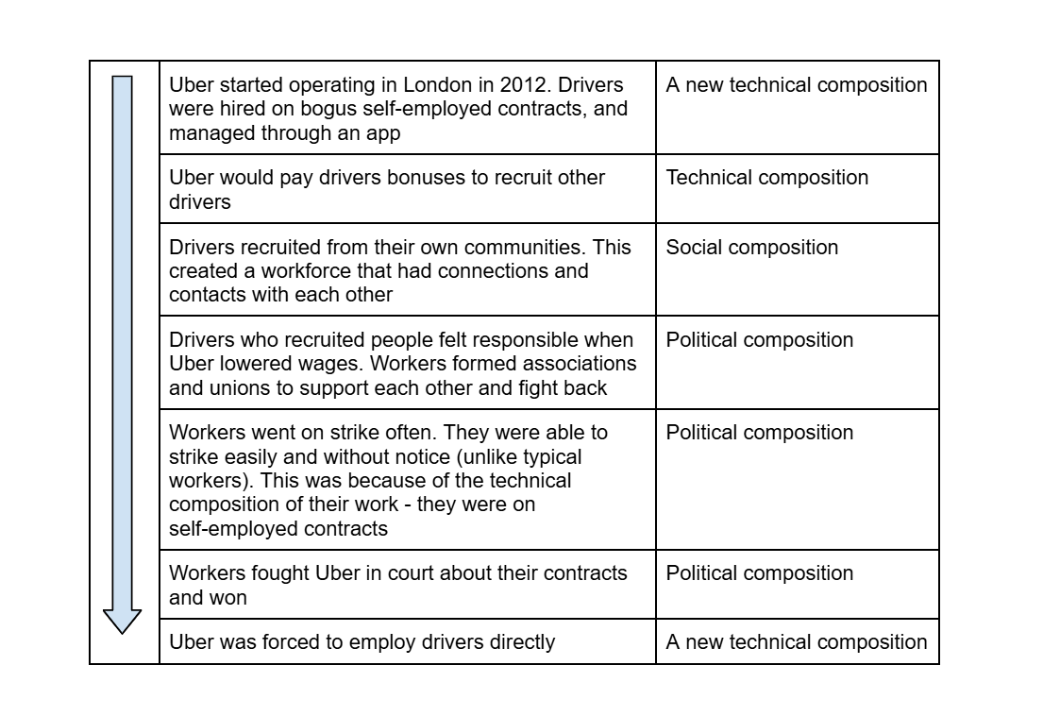
A workers’ inquiry might not be tidy, and might not obviously reveal the state of class composition in the way we’ve outlined above. It might be that aspects of ‘technical’ and ‘social’ are difficult to separate out. In reality, these things are rarely separate in people’s lives. But class composition should be understood as a framework which helps to analyse the results of a workers’ inquiry. It can help to separate out and sort findings from an inquiry using the different categories (technical, social, political). This can make the information you collect from an inquiry easier to manage. It can also help you see relationships which are not so obvious when things are taken all together, and help structure the presentation of your inquiry.
How to start an inquiry
Starting a workers’ inquiry project can often feel daunting. Our everyday work lives are complex and chaotic, so where should we begin? Getting your thoughts down on the page is what matters most. Worrying about the final form your inquiry will take can wait. The right time to start is right now!
Remember: your experiences and insights are important! Often, people starting an inquiry think that the most important details of everyday life and work are ‘boring’ and leave them out. That’s usually a mistake.
Here are some ideas that can get you started:
Start a daily diary. Each day, note down what you observe about the technical, social and political composition of your workplace
- You could: record the tasks you’ve done, the tools and equipment you use, who manages your work and any conflicts you have with your boss
- Compare these notes with your official description or the public perception of your job - what is your everyday experience of work really like?
- Every week, choose a new topic to investigate and focus on in your diary
Start an Inquiry Group amongst your co-workers, in your union branch or across your sector.
- Meet up to start reflecting on the current state of your workplace, the major problems, and how you could start transforming things. If you record your discussions, you’ll quickly have the basis for an inquiry.
Interview your coworkers to involve them. Or have a friend interview you about your work and compare it with theirs.
- What do they have control over that you don’t?
- What changes are underway in their job or profession that are similar to yours?
Think about change. Workers’ inquiry is a tool to help us organise together to transform our workplaces, so you should not limit your thinking to what is currently the case!
- What did your work used to be like? Who implemented the changes, and why? Do you have the power to make future changes?
- If you could change anything at work, what would it be? What is stopping this from happening?
- How could you change your relationship with co-workers? How could you get together to make change happen?
See what else is out there.
- Search online to see if anyone has written about a job similar to your own, and compare your experience with theirs. Could you tell a story about work that is different? What do these accounts get wrong about your job? Are they success stories at organising that you can use to think about organising in your own workplace?
- Think about jobs and roles close to your own. How is the work of others outside your workplace reliant on yours, and who do you need to be working in order to complete your shift?
- Read about jobs other than your own, and consider the key things that make them different, and what similarities might actually exist between them.
Write little and often.
- Regular reflection is more important than getting everything down in one go. If you do just a paragraph a day, you’ll soon have pages of thoughts to work with. Soon, you can start comparing your daily experiences and notice both patterns and unique moments of conflict or tension.
What forms inquiry can take
Once your inquiry is underway, consider how you want to share it with others. Inquiry is a creative process as much as it is a political practice. It aims to open new ways of thinking about how to transform your work, exert power over your bosses, and unite with your co-workers. It is there to be experimented with. The outcome can be guided by how you want it used by others, or by the conversations you want it to help open up in your workplace or sector.
-
A single, one-off document. Edit your notes into a single text to share with others. This could be printed for your staff room or a union meeting (or published on Notes from Below!). You can publish it anonymously.
-
A regular series of writing. Share a series of shorter reflections about your work, like a blog.
-
A digital inquiry. Record videos or audio recordings about your experiences. It could be a podcast series or documentary.
-
Photographs. Share photographs of your work or those that represent your work. Write descriptions alongside them to explain why you chose each image. (We published a whole Notes from Below issue on photograph inquiries).
Inquiry doesn’t have a start and end date, it is a continuous process
Inquiries don’t have a clear endpoint. As time goes on, the conflict between us and our bosses always creates new questions. You will never have a complete set of final conclusions. That said, there will come a point at which your inquiry shifts from gathering information to generating answers. When this change takes place, it makes sense to start thinking about how to do two things with the information you’ve uncovered:
- How to share it with other people
- How to use it in your organising
It’s very difficult to give generic recommendations about the best way to share and use the results of an inquiry, because it can be very different across workplaces and industries. A printed leaflet advertising a meeting might work brilliantly to share the results with workers in a specific hospital, but a podcast or email newsletter might be better for people teaching and working in different schools across a multi-academy trust. Fortunately, the inquiry process should have helped you understand the connections among the different parts of the workforce and how ideas can spread. It might also have started to suggest the next steps for your organising.
You might be surprised at how broad the interest in your results are. There are three potential audiences for an inquiry:
- Your immediate workplace colleagues
- Other workers across the sector
- The wider national and international movement
You are in the best position to reach your coworkers - after all, you work alongside them. But reaching those bigger audiences can be more complicated. You might find routes through your trade union, trade union federation, political groups, or rank-and-file networks. But we can also help. Get in touch with Notes From Below, and we can discuss publishing your inquiry on our website and publicising it to our audience.
Featured in Workers' Inquiry: The Politics of a Method (#27)
author
Notes from Below (@NotesFrom_Below)
Subscribe to Notes from Below
Subscribe now to Notes from Below, and get our print issues sent to your front door three times a year. For every subscriber, we’re also able to print a load of free copies to hand out in workplaces, neighbourhoods, prisons and picket lines. Can you subscribe now and support us in spreading Marxist ideas in the workplace?
Read next

Why Worker Writing Matters
by
Notes from Below
/
April 20, 2020