Challenging the State: Building a Rank and File in Higher Education
by
Rank-and-File University Workers
March 13, 2026
Featured in Class Dismissed: Against The State of Education (#26)
A group of university workers reflect on efforts to start building a rank-and-file across different unions in the sector.
inquiry
Challenging the State: Building a Rank and File in Higher Education
by
Rank-and-File University Workers
/
March 13, 2026
in
Class Dismissed: Against The State of Education
(#26)
A group of university workers reflect on efforts to start building a rank-and-file across different unions in the sector.
This is a collectively written contribution from a group of rank-and-file university workers in the UK. It covers our attempt to build and mobilise rank-and-file power across unions that represent workers in the UK Higher Education (UKHE) sector. We are all members of the University College Union (UCU), which represents academic and professional services staff in Higher and Further education nationally. We discuss how our union works, rank-and-file successes, and our current campaign for a precedent-setting sector-wide dispute with the UK government over the funding of Higher Education. The campaign developed from a series of ‘university rank-and-file day schools’ which we continue to participate in. The day schools have been a significant form of our organising. They centre in-person discussion, a mix of informal and formal coming together, a principle of eating together, and of meeting in explicitly convivial political spaces outside our workplaces.
Knowing the Issues
The disputes in British Higher Education have rumbled on for so long now that many of us have gone from students affected by strikes to workers and union members actively organising strike action over the past 8 years. Throughout this period of industrial disputes, we have had many different roles, from student supporters to casualised union members on the fringes of branches providing the legwork of getting the vote out, to insurgent branch committee members wrestling for control of moribund branches, to finally leading branches within local disputes and driving national union policy in our sector.
Our experience is varied and encompasses many different vantage points of how our union functions and the different levels of agency members feel within disputes. The rank-and-file approach we have adopted in our organising is not merely a political-ideological preference, even though many of us may be ideologically aligned with a ‘socialism from below’ approach.1 It has also been a practical response to a chronic lack of communication and information sharing from our central union. For lay members, accessing information about how our disputes are progressing, what our negotiators are actually arguing for on our behalf, or what the other unions within the dispute think, is almost impossible to understand. Even now, as experienced senior union reps and officials, we struggle to find or interpret what is being argued for in our name.
Factionalism is a major obstacle to members’ understanding how our union works and trying to organise within it. Factionalism in the union has the effect of keeping us in a holding pattern: what appears as opposition keeps us defaulting to bureaucracy and a top-down trade unionism. We have become caught in cycles of one faction posing a poorly worked-out industrial strategy, fighting the other faction to implement it, and the other resisting or eventually pulling us out of it. We are marched up and down the hill, with little input or debate beyond a polarised factional blame game. The most frustrating outcome of this factionalism in the union is not the confusion created by their divisions, but, in fact, it is the unspoken agreement factions have had in sidelining the voices of members. This has been particularly devastating when it comes to the scandal of casualisation that lower-paid and younger members face. And has foreshadowed the union’s inability to challenge cuts to departments, which have triggered a wider redundancy crisis across the sector. This inaction and unresponsiveness from the dominant factions to the issues so many members face at work leaves the deep anger many of us feel untapped and unorganised.
A shared rejection of factionalism, along with the failings of the central union to connect members across branches let alone unions, has been a key starting point for those of us trying to exit the doom spiral of the sector. It has been patently clear that we must take responsibility for building our own rank-and-file structures for communication and action, independent of both the union bureaucracy and the factions that (re)produce it. Between us we have been involved in a number of attempts to build this kind of infrastructure for members to organise and act.
Before the day schools, there have been attempts to cohere rank-and-file efforts, either by creating WhatsApp groups, email threads, or issue-specific campaigns. These tended to get stuck at the question of what to do about the bureaucracy, ending up falling back into the factional tug-of-war over elections, rather than building the capacities of rank-and-file members to act on their own initiative. In the midst of continued strike action across 2021-22, and with a ballot going out to extend the mandate for industrial action going out in March 2022, a group of rank-and-file members identified a need in UCU for a more organised Get the Vote Out (GTVO) strategy. In March, branch activists from across the union held a ‘GTVO Rank-and-File training workshop’ online. It aimed to support members to streamline their branch’s GTVO process by sharing the strategies of branches that had successfully upped their voting turnout. One of the outcomes of this workshop was a WhatsApp group in which members could continue to share best practices in efforts to get their branch over the threshold for industrial action, with members at branches who’d already crossed the threshold even stepping into lesser-resourced branches to help with their GTVO efforts. As UCU moved through a series of aggregated ballots that would see industrial action run well into 2023, the WhatsApp group amassed more and more members, and its purpose morphed over time.
At its best, the group facilitated the sharing of resources and information across geographically separated branches, leading to things like a map of facilities time allocations, which starkly showed the unequal resources of branches and empowered branches to argue for more facilities time. As with many large WhatsApp groups, the discussion sometimes became directed by factional investments, or turned into long-form dissections of, or arguments about, our union’s executive structures and elected officials. These structures are often wrapped in secrecy and a hierarchy of insider knowledge, as no minutes or voting records are produced from them. Once our extended period of industrial action was behind us, the notion that the group represented a rank-and-file approach to organising for the future of the sector felt increasingly distant.
A number of us who have gone on to organise and participate in the day schools saw the value of what this WhatsApp group had achieved as a space for cross-branch organising. We were keen to replicate it, but recognised the need for an in-person component. The COVID pandemic had shifted branch and organising meetings online, and even as restrictions lifted, online calls often continued as a preferred default. This was great for inviting wider participation (those with caring responsibilities or who didn’t live near their place of work could join or listen in), but it also presented obstacles - cameras off, writing in the chat, and dodgy wifi connections all made it difficult to find the space needed to rebuild branches and trust after exhausting industrial action, and to have bigger conversations about wholesale changes in the sector.
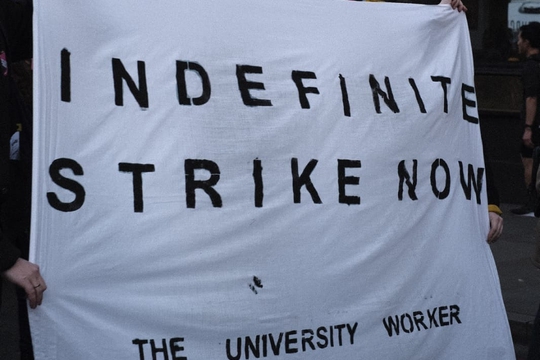
The University Worker is a rank-and-file bulletin started in 2018 during the USS pension dispute. It is printed out and handed out on the picket lines and published on the Notes from Below website. The bulletin has been an information-sharing and agitational tool, and a longer write-up of the bulletin’s history can be found in issue 17 of the Notes from Below.2 The bulletin has acted as a political centre, drawing together workers in the sector aligned with rank-and-file politics. Reading the bulletin, it was clear that as the situation in our sector deteriorated further, with a wave of redundancies sweeping across universities, our unions woefully failed to address the moment. They lagged behind in even recognising and naming the crisis that was unfolding, one which has now become the dominant feature of the sector. The urgency of the redundancy crisis and the absence of unions in addressing it nationally meant that we needed to go beyond a bulletin and take responsibility for organising across our branches and unions to fight back.
After long conversations on picket lines and in the pub, there was a clear sense of what needed to be done. Cultures of communication across branches, where best practice and innovative approaches can be built on, were already happening, but without any organisation or shared strategy. We know that our management bodies talk to each other, that when one has some nasty scheme locally to push the boundaries of how much labour law can be flouted, this spreads to other workplaces and workforces like a virus. We also know that union bureaucrats looking for an easy life by suppressing activity, learn from each other too. Knowing what the issues are is one thing; building an organisational solution is another.
The Day Schools
We organised our first day school in March 2024. It came in the wake of both the UCU general secretary election and a continuing lack of response to the crisis in higher education. The format of the day school took inspiration from the Workers in Palestine event a few months before, which brought together workshops and talks. During a period in which in-person meetings still had some post-COVID novelty, this longer format provided much-needed face-to-face organising space.
The first day school was relatively straightforward: we booked a room, spoke to people about what might be useful in an event, and started promoting it. The first session focused on discussing the funding crisis in higher education. This is an issue that deeply shapes our experiences of working in higher education, but was rarely discussed in union spaces (other than “of course, we’re in favour of free education, but that’s not part of this dispute…”). The second session was a practical workshop on how to organise against redundancies. The results of the session were later written up into a shareable document.3 After a collective lunch, we returned for a session on Palestine and international solidarity, led by Workers in Palestine. For the final session, we hosted a discussion on how to build rank-and-file power at a university. This first day laid down the blueprint for the day schools that we would continue to develop. They involved a mix of discussions and practical sessions, with a focus on trying to develop resources that could be used more widely.
It is also important to note that we wanted these meetings to feel very different to the union spaces that many of us organise in locally. First, they were open to anyone who worked in the university, rather than just members of a specific union. We started the first day school with a caveat for participation: “If you want to complain about the national leadership or talk about factions in the bureaucracy, this isn’t the space for that.” Instead, we wanted a participatory space in which we could think collectively about the problems we were facing. In terms of developing the day schools, this meant experimenting with how we could share knowledge and strategies with each other. In part, this is why these had to be “day schools” rather than just “meetings.” If we had met for an hour or two, we would not have been able to get into the topics in the same way.
We organised day schools roughly monthly, skipping some months depending on the time of year and other activities. We deliberately avoided booking any of the day schools in university spaces, and encouraged new attendees to participate in organising and running new sessions. To aid this, we tried to allocate time at the end of each day school to plan our next session, setting up a smaller group of volunteers to lead on organising. Attendance fluctuated a great deal, but gradually we began to develop a core group of rank-and-file members whose workplace organising informed the topics covered in the day schools. This included funding cuts, redundancies, casualisation, Palestine solidarity, industrial organising, and building cross-union power. In order to understand the state of union organisation across the sector, we developed a survey of branches. In collectively assessing the responses within the day schools, we realised that not all institutions had active union branches with basic structures, and that day-to-day participation varied massively. We also realised that some people found it difficult to access the information and advice they required to organise effectively. We wanted to equip people with the kind of knowledge that would facilitate workers’ self-organisation. This involved encouraging others to share their experiences and collectively produce resources informed by prior struggles. For example, in the workshop on how to organise over redundancies, we discussed the technicalities of the process of building towards a local strike ballot, as well as the political barriers people might face, from both inside and outside of their union. The emphasis on a bottom-up approach to organising informed the resources which were produced as a result, these included a guide to building an anti-casualisation network and campaign, as well as an organising guide for rebuilding branches. Our overarching aim has been to facilitate rank-and-file union organisation, by this we mean a form of organisation which is worker-led and enables democratic, participatory engagement in decision-making, strategy, and campaigning.
The Secretary of State Dispute
At the start of 2025, we shifted the focus of the day schools. Redundancies were escalating across the sector, and the absence of any national union strategies became particularly stark. In advance of the January day school, we put out a call for written submissions to discuss how we could respond to the growing crisis. Sharing writing in advance of the day school allowed us to begin working through concretely what was possible and what we could do. We held the January day school at MayDay Rooms, a social movement archive and event space in the centre of London. After getting drenched waiting in the rain for whoever of us had the keys, we sat around a long table in the kitchen. The first session of the day was discussing the papers that had been sent in. The papers collectively registered an existential crisis in HE, all trying to work through what the sector is actually for, the political economy of the university today, and given the dismal answers people came up with to those questions, why save HE? Our discussion that day was circling around the need to develop a national campaign that could take on the question of funding.
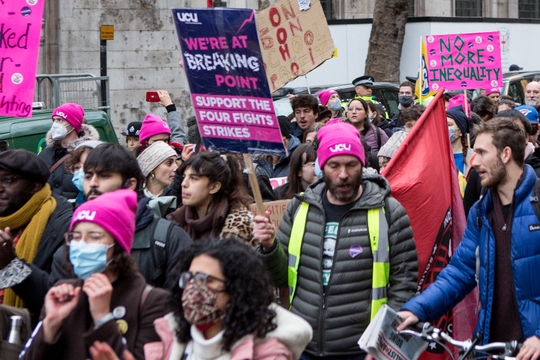
Rather than fighting redundancies on a university-by-university basis, we wanted to find a way to deal with the cause of the crisis, not only the symptoms. We discussed that such a campaign couldn’t develop only in the room; it required getting organised with comrades in other campus unions, with local communities in the areas where we work, and of course with students. We need to be collective not only to materialise and fight such a dispute, but to begin to work out what we want to win, what university we are fighting for. In our own branches we also would need to navigate the bad feeling after the recent collapse of the UCU Four Fights campaign. The collapse of that campaign had multiple spectacular fallouts: from the redundancies we had met to discuss, to branches facing hundreds of days of salary deductions as a result of a brutal employer response to the marking and assessment boycott. As we talked, some of us started making lunch. We stopped and ate together, took a break on the roof terrace, got to know each other a bit better, chatted informally about our experiences in our branches. The second half of the day was led by comrades from anti-casualisation campaigns led by postgraduate researchers and teaching associates. Their struggles were inextricable from what we had discussed earlier in the day, and they brought more knowledge and fronts to our fight - from questions of whether or not UCU would support wildcat action, to the relationship between our employers and external research institutes and companies.
All this is about funding. The challenge we had was to work out how we could actually strike over something like funding. Under UK law, political strikes are illegal. We therefore had all been told - from both the left and the right factions of the union bureaucracy - that it simply wasn’t possible to do something like this. Instead, we needed to strike over pensions or pay, but “wink, wink”, we all would know it was actually about much wider demands. At the end of the January day school, we set ourselves the task to find out how a national dispute could be feasible.
A group of us started searching for examples from other public sector unions. We also read through the Trade Union and Labour Relations (Consolidation) Act 1992 (TULRCA), to try and understand whether there was unexplored industrial and legal terrain we could exploit. And we found that under s244 of TULRCA, a dispute between a Minister of the Crown and workers can be treated as a dispute between the employer and workers if the dispute with the employer cannot be settled without a minister intervening to exercise a power conferred on them. According to the Higher Education and Research Act 2017, the Secretary of State for Education has statutory powers (via the Office for Students) to alter the fee cap and make grants. We also found that in 2016, the National Union of Teachers had successfully defended their right under s244 to hold a one-day strike against the Secretary of State in a dispute over funding for Sixth Form (post-16) Colleges.
The strategy of pursuing a trade dispute with the Secretary of State for Education over the funding model for HE developed out of discussions at the January day school. We then organised a series of further meetings to discuss the strategy and how to begin a campaign around it. These discussions were distinct from the day schools in that they were held online, for no more than an hour, usually in the evening. As a rank-and-file collective, we agreed that such a strategy required legal advice, for which we raised funds through our respective branches. We commissioned legal advice and drafted a branch motion on carrying the trade dispute to a motion at the annual UCU congress. The motion committed the UCU to urgently explore opening a trade dispute with the Secretary of State for Education over HE funding; coordinate with other HE unions and students to build wide support for the dispute; and campaign to build awareness and support for the dispute. Work on the motion and fundraising for the legal advice involved further conversations with members, branch representatives and branch committees. This resulted in many UCU branches (including Queen Mary, Goldsmiths, Kingston, Essex, UAL, Durham, KCL, Liverpool, Oxford, Nottingham, and UCL) passing local motions in support of the UCU Higher Education Sector conference motion (HE14).
Getting a motion on the agenda for the national congress was one step in the wider strategy. Members continued to present the motion in their branches to build support for it at congress, and to use the motion to hold much-needed discussions about areas of branch and national work that urgently need reflection and action - industrial strategy, sector funding, and branch resources. We also learnt from the kinds of discussions branches were having about what excited and what concerned members about the motion. Different branches have wildly different cultures, and although all UCU HE branches were facing some kind of issue that the motion addressed (mass redundancies and the overall degradation of our terms and conditions), these challenges were differently felt, differently challenged, and taking up different kinds of branch resources. Sharing the conversations in branches helped those of us who would be presenting the motion at congress to understand what we would be walking into in terms of support and opposition, and what concerns our statements for the motion would need to address. It also kept us committed to the purpose of the day schools: to make a participatory space for thinking through and collectively plotting responses to the problems we face in work.
The annual UCU congress takes place in a large convention centre in a city somewhere in the UK. On the second day of the congress, the union splits into its two sector conferences, Higher Education and Further Education. In the sector conferences everyone is sat at long tables facing the stage where a mix of elected officials and union bureaucracy preside over events. Delegates go to a podium to present the motion; then follows a debate chaired by the president, which takes the form of delegates speaking for and against a motion, for no more than two minutes each. This set-up is barely conducive to getting through the agenda, and it is definitely not a space in which you can hold a consensus-building discussion in the round. It is a debate-style system that favours those who feel comfortable holding the floor and responding in the moment. As a scene, it can feel deeply alienating for many delegates: you watch lots of people who have worked closely together over many years (but are organised into opposing factions) run up and down the aisles in heightened urgency to get their motions passed. The agenda is long, and most branches will have had little or no time to discuss the hundreds of motions and their consequences before sending delegates. Our preparation for the May 2025 Congress included discussion about how congress itself works to make sure anyone attending for the first time would know what to expect. We knew we would have limited time to present the motion, so we decided to hold a fringe meeting for the evening before the sector conference. The meeting followed the format of the day schools and took place in a social non-institutional venue (this time a bookshop). Everyone attending congress was welcome. We made flyers about the motion and the fringe event to hand out at congress and on WhatsApp. Those of us based in the city encouraged members from the other local university union branches to come to the meeting. At the meeting, we presented the context and details of the motion and then had an open floor discussion. Members from across the union attended. It was a generative and positive discussion. After the meeting, we went for pizza. Several people at the meeting said they found the discussion energising, and they had never attended a union meeting like it. This makes sense given what we have learnt in previous day schools and from our survey about the variation in branch cultures.
The motion passed overwhelmingly. Lots of delegates we did not know came up to talk to us about the motion, and acknowledged the care we had taken in how we presented it, navigating the divides within the union that often structure congress voting. Other delegates wanted to talk more about the next steps, or their concerns about how the motion would be taken forward, or not, by the Higher Education Committee. The motion was, both before and after it passed, being used by various elements of the union as part of already existing agendas. Everyone from the General Secretary to UCU Left spoke to the press about it, attempting to frame the motion in relation to the previous UCU strategy. These discussions and machinations helped us start to think about what might be needed after congress to get the dispute to happen, and the kinds of meeting and organising spaces we would need to support the dispute and our wider unity.
The long-term success of the strategy and dispute still very much depends on a broad rank-and-file campaign. We therefore called a series of national meetings across June and July to explore how to organise a trade dispute over funding in HE. This felt like a daunting task, especially given how many of us are engaged in local disputes, fighting redundancies and cuts within our branches. However, it was clear from these meetings that many of us realise the underlying causes of our local struggles, as well as those over pay and conditions more broadly, are structural, and the current HE fee-based funding model is core to that. While pursuing a dispute over funding is something distinct from our local disputes, it is also about linking up these multiple defensive struggles we are involved in and getting on the front foot to challenge the root causes going forward. In a moment of crisis within the sector, this feels vital.
As a result of these recent national meetings, multiple UCU branches have passed a post-congress motion, committing to help organise a national dispute over funding. In addition, a series of new regional and cross-union rank-and-file groups and day schools have been established to contribute to this organisation. By collectively working on this strategy in this way, we hope it will not only further our fight for HE but also energise the form of participatory, worker-led organisation across branches that has given rise to this campaign. Together, we are building a cross-branch, cross-union reps network in higher education.
Subscribe to Notes from Below
Subscribe now to Notes from Below, and get our print issues sent to your front door three times a year. For every subscriber, we’re also able to print a load of free copies to hand out in workplaces, neighbourhoods, prisons and picket lines. Can you subscribe now and support us in spreading Marxist ideas in the workplace?
Read next
UCU and the University Worker: Experiments with a bulletin
by
The University Worker
/
April 28, 2023