Yarmouth Workers’ Project: A Territorial Inquiry
by
Lotte,
Dan
June 10, 2026
Featured in Workers' Inquiry: The Politics of a Method (#27)
The beginnings of a territorial inquiry in the heartland of Britain’s rising far-right.
inquiry
Yarmouth Workers’ Project: A Territorial Inquiry
The beginnings of a territorial inquiry in the heartland of Britain’s rising far-right.
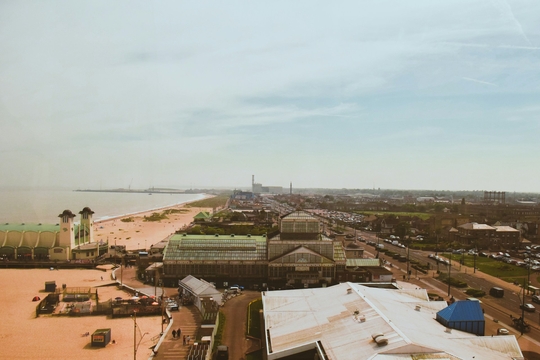
The story of Great Yarmouth is not unlike that of other British seaside towns. Geographically out on a limb, the town sits at the edges of East Anglia, closer to Holland than London. It was once a major hub and fishing port for herring and trading, which fell on its fortunes in the 1960s once new vessels led to overfishing. The town’s economy quickly pivoted to the oil and gas industry, and as a popular holiday destination for the working classes. These days the town has high levels of unemployment, high rates of crime, boarded up shops, and multiple neighbourhoods are ranked as some of the most ‘deprived’ in the country. In this sense it’s far from unique against the backdrop of disintegrating towns across Britain. It’s been a Tory safe seat since 2010, owing to the more affluent villages and rural exurbs that surround the town and make up the majority of the borough’s population (70,000 vs. the town’s 30,000). It was this same electorate that catapulted Reform to win one of their first seats in the 2024 General Election, in Great Yarmouth.1
For nearly a decade we have seen the town go through its cycle of changes: businesses shuttering their doors, successive waves of migrants arriving to work in the wider region’s fields and factories, public services substituted with heritage “regeneration” grants and “business parks,” HMOs ballooning to accommodate low-wage workers, the relocation of shops and supermarkets to retail parks on the town’s outskirts, a newly-operational port, the seafront heaving in summer and deserted each winter, the British flags lining neighbourhood perimeters—like a modern day reanimation of the town’s crumbling medieval walls.
Why Workers’ Inquiry?
One of us began working in Yarmouth in 2017 doing community work out of a hub in the centre of town, which closed when covid hit, and then moved into a community engagement role in the health sector. The other lives and runs a space in the centre, which is where our inquiry is based out of. The space hosts a range of activities, including creative writing sessions, printing and publishing local writing, and a weekly self-organised homework club for kids in the local neighbourhood. The space is unfunded and unwaged: rent/bills are paid via memberships, whereby people in and beyond Yarmouth contribute a few quid a month, and in return receive a copy of every publication of local writing, and can use the space for free. Over the years the space has developed into a place where people in the neighbourhood come to socialise, and sometimes to ask for help with something specific (e.g. topping up a mobile phone, calling about a bill, etc). This pragmatic help has always been done on a personal basis, individually rather than collectivised; but through this, strong networks have been built around the space itself. This is significant in the absence (and closures of) community spaces in town over the years, and in that it tries to work against the very visible segregation in the town along nationality and language lines. Previously one of us had worked at a drop-in run by a local migrant support organisation, now teaches at the local college, and was involved for several years in a DIY space down the road that put on punk gigs, film screenings and other events before it was evicted. In a town you can be hyper-visible, constantly bumping into people, and naturally you get to know a lot of people.
We began the inquiry around a year ago. Inspired by the practice of workers’ inquiry, we wanted to conduct in-depth investigation into class composition and working class experience in the town. We wanted to turn the process of reflection into activity in its own right, using inquiry as a tool to orientate our political organising rather than as an endpoint in itself; and to root our practice within (and as an expression of) this class experience. We felt that it was important to understand and recognise the material reality we find ourselves within, not only as we would like it to be. Over time we’ve found this has helped give our activity a sense of structure and purpose, and break us out of pure polemic or disconnected ‘activism,’ often based on romanticised or misinterpreted analysis that bears no real relationship to the conditions we find ourselves in. Yarmouth has no shortage of academics who flock to study another ‘left behind’ coastal town, armed with their predetermined conclusions and no real understanding of the place. Enthusiasm or interest is not a substitute for time simply spent in a place, and our desire was also to formalise the knowledge, understanding and experience we had already developed over the past years of living and working in Yarmouth, and as a possible means from which a practical and conscious class politics can develop.
Long before Reform’s win locally, we have continually returned to the question of how to orientate political organising in Yarmouth, attempting and experimenting with various approaches over the years. In these approaches we have always sought to be specific to place, and the town’s particular material conditions—refusing to simply transpose strategies or priorities wielded in the completely differing context of cities. Yarmouth has lacked any notable leftwing presence (be that population, spaces, projects, or unions) since the 19th century, when William Morris and the Socialist League once agitated among the town’s streets, attracting large crowds in support.2 From the beginning of the inquiry we’ve felt it important that the process is experimental and open to flexibility—to learn from doing and to adapt accordingly, while at the same time continuing to articulate what we’re doing and why. It is largely this tension between theory and action that has sustained our inquiry so far, as well as explicitly opened up possibilities we hadn’t first imagined or planned for.
Prior to the inquiry we were already familiar with working conditions in the region’s poultry factories, whose workers are housed in Yarmouth, often in HMOs via recruitment agencies. The residential base for factory work across the region, workers commute for day and nightshifts via long coach journeys organised by the factories. These workers (mostly EU migrants) operate in treacherous conditions: long hours, low pay, accident-prone equipment and unsafe clothing, freezing cold temperatures, bullying and harassment, deliberate manipulation of workers along national/racial lines to encourage division, and no regulation or oversight from labour inspectors. These conditions, and the relationships with people working in them, contributed to our initial thoughts on a workers’ inquiry: this was partly because it felt like—despite workers being all too aware these conditions are ‘bad’ and exploitative—they have in many ways been completely normalised, with a general acceptance of being ‘just the ways things are’ under capitalism, and can’t be any other way (it’s important to note that this comes on the heels of over two decades of factories firing anyone who so much as complains about their working conditions. We have heard from multiple workers of physical intimidation and “accidents” after complaining). As well as this, most ‘solutions’ when workers are inevitably fired (or simply not called into work, as most are on zero-hour contracts via agencies) are individualised: they simply look for another job—a strategy compounded by the widespread scepticism and bad experiences of mainstream unions. Before beginning our inquiry, we recognised within the factories the potential to help to create the conditions for self-organisation and self-reflection that encourages all of us to reassess our experiences—not to organise others, but alongside those we have initiated dialogue and developed relationships with through the inquiry.
Workers’ Inquiry meets Territorial Inquiry
We think of our inquiry as a territorial one, in the sense that it is deliberately rooted within a set geography,3 and while heavily focused on workplaces we have also attempted to explore aspects of life outside of work. We chose this place-based approach, instead of an inquiry into one specific workplace or industry, partly due to the composition of the town itself. Yarmouth has high levels of unemployment, with large numbers of residents long-term out of work (many surviving solely on disability benefits), and a surplus population continually switching jobs while swinging rapidly between no work and working overtime. In a town this size, we also saw the potential to be able to map out the relations between industries: for example, the industrial laundrette that services the town’s holiday parks and hotels.
We also wanted to get a better sense of demographics within certain industries. We were already familiar with the fact that the majority of jobs in the poultry factories were overwhelmingly worked by EU migrants (predominantly Portuguese, Polish, Romanian, and most recently Roma). But other workplaces were less clear: what about the supermarkets that line the outskirts of the town? What about the holiday parks—their cleaners, bar staff, receptionists, caretakers, security? Yarmouth is pretty geographically segregated along lines of nationality and language, and given this, we were curious to what extent workplaces mirrored this segregation (or not). In otherwise fragmented communities, larger workplaces can act as nodes, where people are pulled into a single location and a shared set of experiences. This line of inquiry could also serve a second, important purpose: to understand what shared material conditions might exist at the point of production, whether self-organisation and class-based affinities and solidarities already exist in certain workplaces (or could), and how they sit against affinities based on nationality or language lines. We also didn’t want to reduce people to just their work. We set out wanting to have a more formalised understanding of people’s housing conditions, their political beliefs, how they view the place they live, and what does, or could, make life good.
We recognised that organising around issues in workplaces like the poultry factories may actually be more readily approached in the neighbourhood first, than the workplace (in factories spread across the region). With high densities of workers from factories living in the same areas in the centre of town, there’s an opportunity to begin building a base of organised workers away from the prying eyes and repressive practices experienced within the workplaces.
With the rise of far-right support in the area—and the future potential this has for becoming a collectively organised force—we wanted to see whether shared material concerns at the point of production (the workplace), and to some extent the point of reproduction (the community), could be a way to simultaneously:
- draw people toward a new political imaginary;
- build class based affinities, as opposed to national ones;
- to expand people’s sense of what is possible;
- offer space, resources and collectivised support to develop skills and structures for working class self-organisation (all while hopefully making small gains in people’s immediate standard of living/subsistence struggles).
Industry Focus
We began with sector mapping using the website Nomis, which provides an easy way to access census and labour market statistics. We reviewed the top 5 industries in each of the 3 electoral wards in town, looking at the percentage of people employed by industry, and then combined the data from all 3 to give us a picture of the main industrial composition of the town.
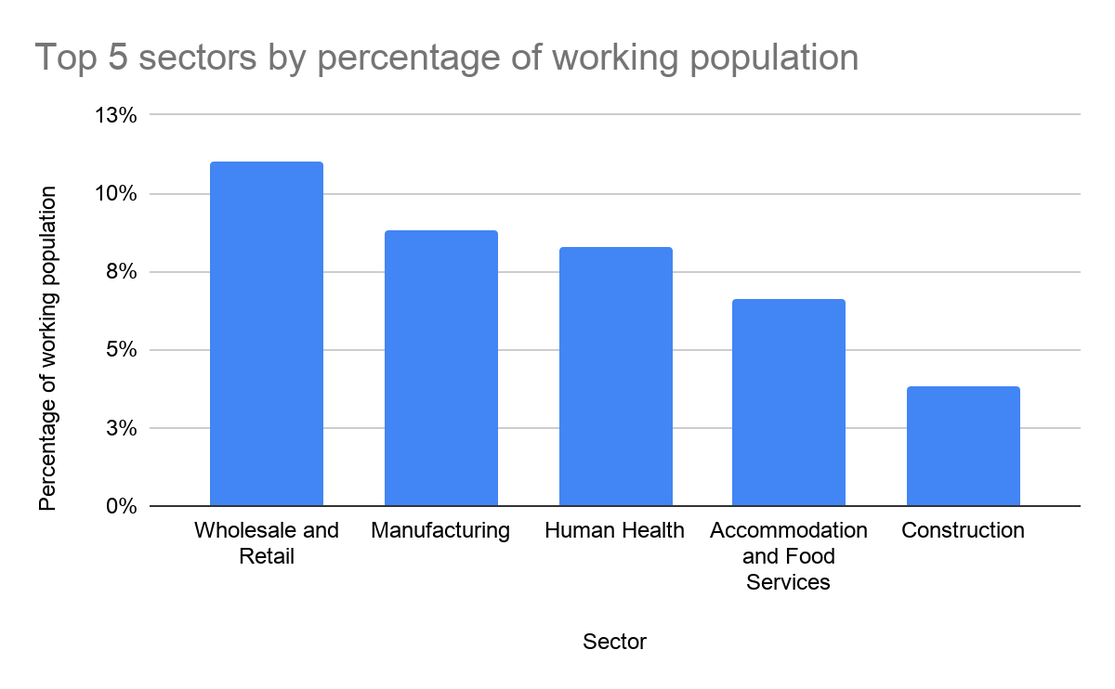
Our original intention was to engage with workers from across all 5 of these sectors to try and gauge the composition of each. While we have managed to gain insights into some of these, especially Manufacturing, and Human Health, it quickly became apparent that trying to cover all 5 simultaneously was an undertaking too big.
The plan was to spend a year data gathering, and then produce some sort of written account of what we had learned, to share with workers across the town and in similar places across the UK. However a year wasn’t anywhere near long enough to do everything we wanted to, and in our commitment to experimenting and being present to what we found, we wanted to follow tangents and deviations that made sense as they came along.
We are currently preparing to shift a large part of our focus to the town’s holiday parks (Accommodation and Food Service). This is for a few reasons. Within the poultry factories (Manufacturing) we have good connections and a good understanding of it, and we are now developing possible ways to support workers in organising (see below). Our focus with Human Health has been care work, and as with the factories, we are providing resources for organising among care workers. The challenge with this sector is that it is very dispersed across small care homes or individual houses, and the workers can be difficult to reach.
This narrowed our focus to Wholesale and Retail and Accommodation and Food Services. These both provide convergences of large numbers of workers. We have settled on the holiday parks because they are particularly representative of Yarmouth and similar seaside resorts, as well as playing a big (and potentially powerful) role in the town’s economy—largely dependent on tourism—and are a prominent part of working class experience here. It’s also good timing because the season is approaching and the parks are taking on large amounts of new and rehired staff. The people we have had less opportunities to engage with are British workers, the same demographic that Reform and now Restore Britain are vying for the attention and support of. Workplaces with a more balanced composition of British and migrant workers, here the holiday parks, will hopefully provide more opportunities for using workplace struggle to build class solidarities, and challenge the narrative of surging far right parties.
Methodologies
We have been using a range of methods to gather our data that run along a scale of involvement. So far we have conducted surveys, interviews, group discussions and Know Your Rights workshops, and are about to begin working with workers to produce their own writing. What we hoped would happen was that one method would lead to involvement with another, creating a natural progression through the inquiry for the people involved. We were also successful in applying for some grant funding from the Barry Amiel & Norman Melburn Trust to support this work. Our intention was always to conduct the inquiry regardless of whether our application was accepted, but the grant has made it easier to cover things such as printing leaflets, translation and interpretation, providing compensation (see workers writing section below), and producing a publication later on.
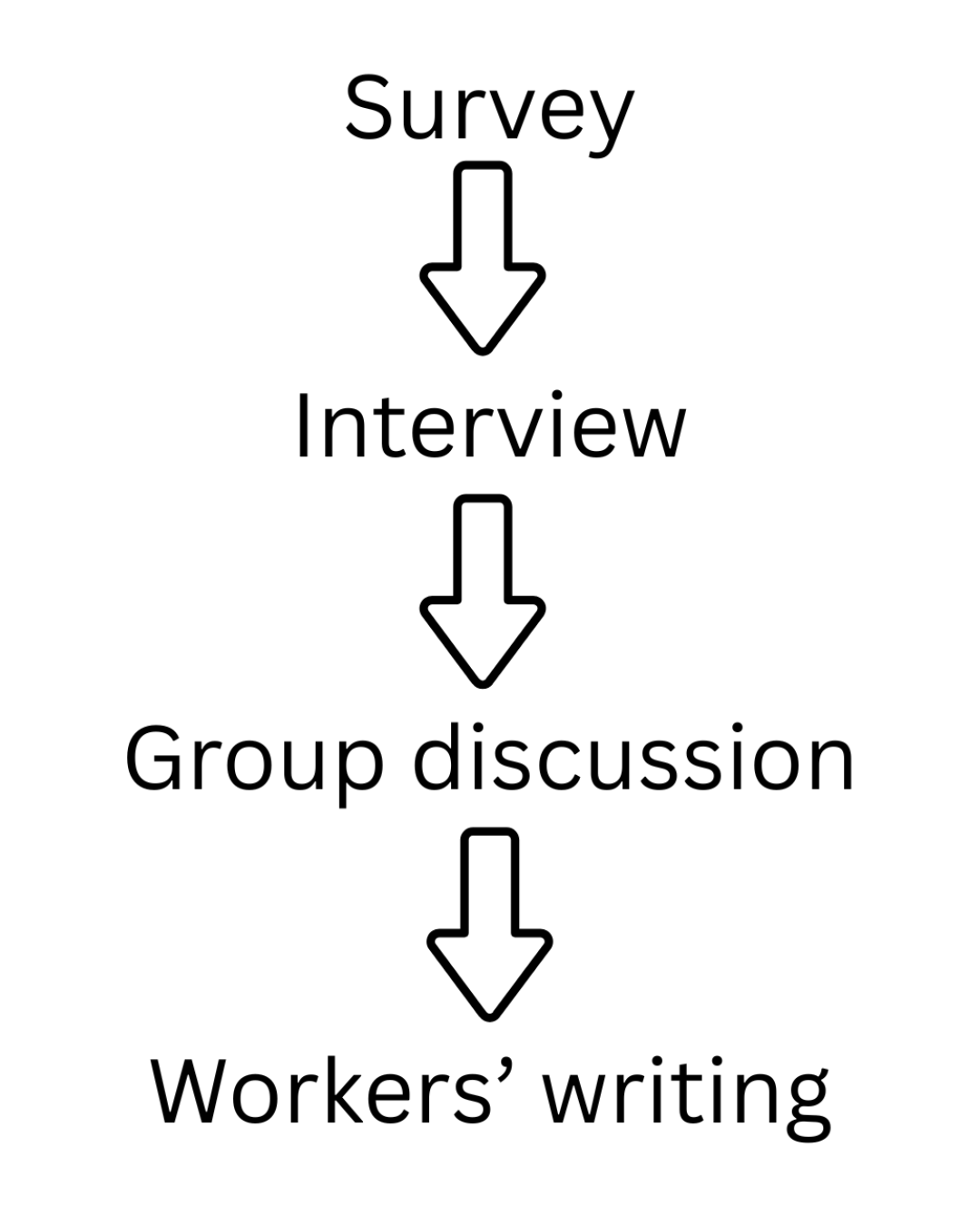
Inquiry flowchart
Survey
The least involved methodology in terms of time commitment or buy-in, we planned for this to reach the largest number of people. It doesn’t require any pre-existing relationship and can be distributed widely. We expected this would help us identify people who could become involved in other aspects of the inquiry (an interview, attending a group discussion, etc), and build up a wider network. This method of engagement was very time-consuming for us, and less impactful than utilising existing relationships we had with workers for more in-depth discussions. For the most part the survey did not produce the natural journey into other parts of the inquiry as we had expected it might, but in the instances that it did we were able to use this to prepare for extended conversations.
Interviews
Using interviews has been good for a number of reasons. It has allowed us to tailor our questions to a specific industry and workplace, and explore points in depth as they emerge during the conversation. Where people being interviewed had previously completed the survey we have also asked them to elaborate on certain points. There have been times where people we’ve done the survey with have been confused or surprised that we would find any aspect of it interesting, and having these longer form conversations can make it clearer, and give more time for self-reflection as well as space to think about what is interesting about their perspectives on work. While we have engaged with some complete strangers in the inquiry so far (and want to further), everyone that we have interviewed up to this point has agreed to do so in part due to a direct, or indirect, personal connection, and we have found utilising these existing relationships and their wider social/work circles crucial for the inquiry. Despite the interviews being informative and useful for drilling down into specifics, they can still feel quite limited. The conversations feel isolated and only go so far in terms of politicising work.
Group Discussions
Group discussion has been the most fruitful form of information-gathering for the inquiry, and knowledge/experience/skill sharing among workers. So far we have tried to bring people together from the same sector (e.g. care work) so that people have a shared frame of reference. These have produced much livelier discussion than interviews, with people bouncing off each other and sharing the things that they struggle with at work, or approaches they take to mitigate these at an individual level. We have seen impassioned debates about whether people should be involved in trade unions. These seem to have a lot of potential for developing a collective approach to workplace struggles. It can be difficult finding a time that works for everyone, especially with shift work and caring responsibilities. As with the interviews, it has been helpful to have existing relationships with people in the area: they have often joined as a favour, or with sceptical curiosity, but left telling us it was an interesting and useful experience, and have since attended follow-on activities (e.g. Know Your Rights sessions, union rep training).
Workers’ Writing
We are now at a stage where we’ve been able to identify people who may be interested in producing their own writing about their experiences of work. This has been challenging because it requires more time and attention than our other methods, despite being able to pay people for their contributions. We don’t want it to be purely transactional, but we also want to acknowledge the time and effort put in given that we have the resources via the grant. To help give a bit of direction we’re creating a guide, but we want the process to be as free and open as possible for contributors. We hope that the act of writing will be a clarifying experience, not just for the writer but also for other workers through sharing this.
Know Your Rights workshops / Rep Training
Not part of our original plan, we had the opportunity to host a Know Your Rights session for workers in Yarmouth last year, and felt that it could complement the inquiry. Our first attempt at a KYR session turned into an impromptu group discussion instead, but this was incredibly valuable. Although attendance was relatively low, we were informed that it had generated a lot of interest among workers in the poultry factories (flyers had been handed out at coach stops across town). Some workers came by the session to scope it out, and we were told that there had been suspicions discussed in the factories that the session was some kind of “trick” organised by their employers. As a result, we are developing these sessions to be a consistent part of the inquiry, so that people begin to recognise and trust them across town. These have also been a good way of building connections with other workplace organisers and union activists.
Alongside this we have organised some workplace rep training through IWW, which some people who have engaged with the inquiry so far will be attending. We know that there are already workers—for example in the poultry factories—who are doing casework for fellow workers, and we have invited them, hoping it will be an opportunity to build confidence, capacity and skills, including our own.
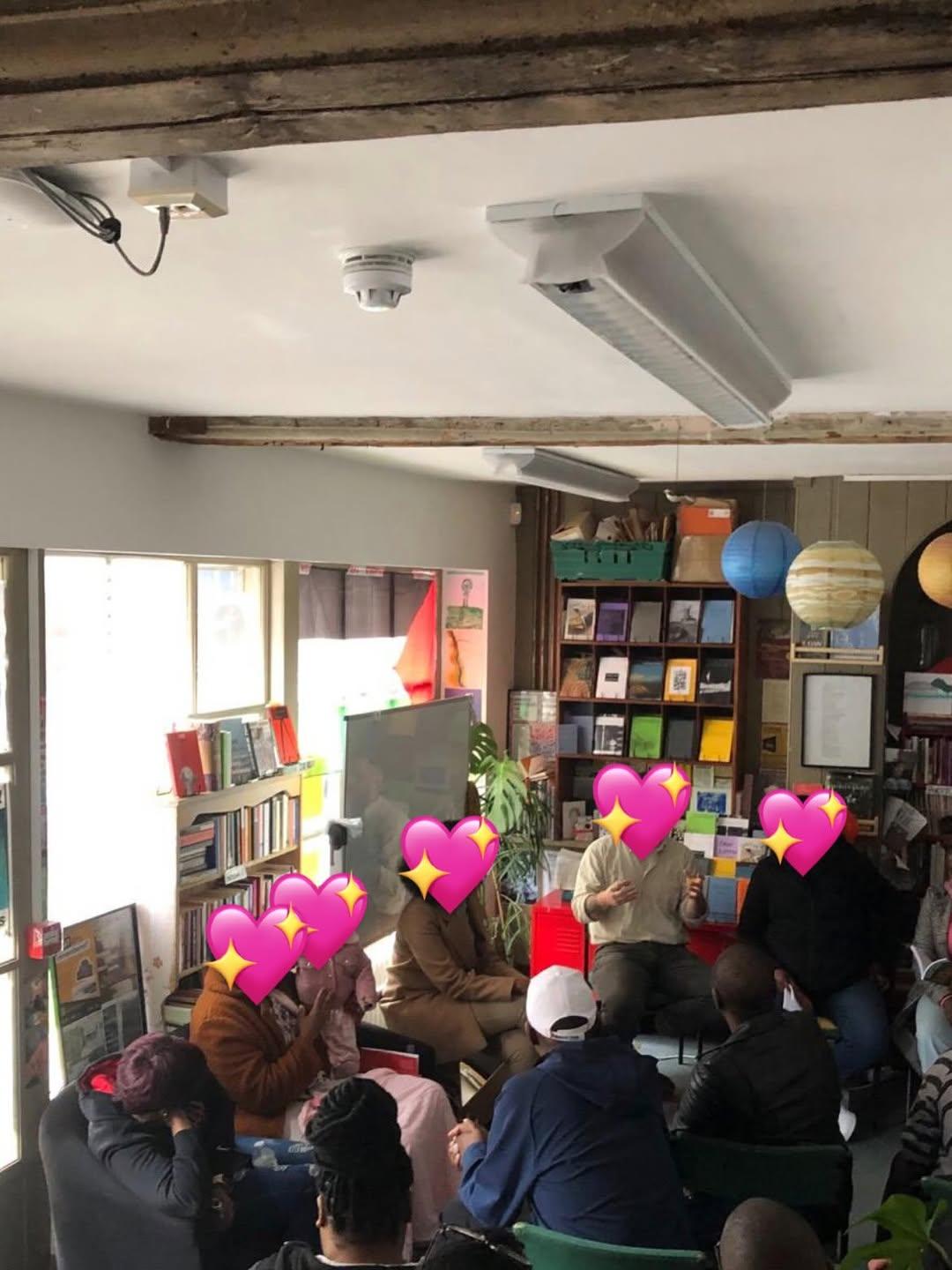
Notes from Below social care issue launch in Great Yarmouth
Additional challenges
Yarmouth is dominated by voluntary and public sector organisations (many of whom do good work if the goal is to mitigate immediate crisis situations). The problem with this for us is twofold. First, it’s a constant battle not to get drawn into the ecology. There is a steady barrage of emails and requests for collaboration with a deliberately de-politicised sector based on service provision. Second, this sets a level of expectation among people living in the town. People can’t initially distinguish between your project and any other charity-based project. This, in combination with a myriad of other factors, has led to an atmosphere and dynamic powerlessness, and a sense that if you want your problems fixed then the only way is for someone else (usually wearing a lanyard) to do it for you. While we recognise that a possible meaningful next step to expand a sense of possibility is to begin doing individual casework, which would likely gain some easy wins, this could very quickly spiral into permanent firefighting without ever having time to collectivise and politicise responses to these issues. In a town where you see the same faces on the street day in, day out, you could quickly become overwhelmed by people approaching you with endless problems, a very real occurrence for anyone working in the voluntary sector here.
Reflections and next steps
We didn’t really know what to expect when we began with this project, other than that we would likely have to make constant adjustments in response to the ongoing developments of the inquiry. We had possibly thought that it would be a succession of compartmentalised stages—with the inquiry first, and then there would be an end point at which stage the organising proper would begin. Instead we have come to understand that our inquiry would be tentatively forever, and that there’s not always a clear moment where inquiry ends and organising begins, instead occurring all at once. A year in, there’s a lot of positive developments for us to reflect on, but there’s even more that we have yet to do. We have some short, medium and long term goals for what comes next.
A crucial missing element is reflecting and returning our findings back to the class. Up to this point the experiences we have gathered have flowed into the inquiry, but not back out again. It’s easy to get caught up in this side of things and lose sight of the need for these experiences to be amplified and returned back to workers to be used in class struggle. We will soon be creating a mailing list and WhatsApp channel to keep more consistent dialogue with people showing an interest. One good thing about a town is you’re often bumping into people, but it can be just as easy for people to fall off the radar. We also want to begin producing a printed multilingual bulletin that can be distributed across town, with short writings on our findings so far, providing space for workers to share their thoughts and experiences directly, and promoting workshops and meetings. If we can get others involved in producing this with us, even better!
A natural outcome of our efforts so far is an evolving calendar of events, workshops and training. Upcoming events include workplace rep training, a Notes from Below Issue launch (on care work), and a collaborative Know Your Rights session with the Pan African Workers’ Association (PAWA). Over the next year we will make this a consistent and reliable feature of the project.
To create a sense of familiarity and continuity across the various strands of the inquiry it also feels like the right time to formalise things with an outward facing identity, under the umbrella of ‘Yarmouth Workers’ Project’. Hopefully this can help contribute to producing a clearer narrative of who we are, what we’re about, and importantly what we’re not (e.g. charitable service provision). Long-term we hope that this can develop into a longstanding working class institution for Yarmouth in the form of a Workers’ Centre, but we need to be in a position where there is involvement from other workers in making this a reality.
-
For more info on these electoral dynamics in Yarmouth, see: https://redherringpress.bigcartel.com/product/an-economy-of-starlings-by-lotte-ls . ↩
-
Revolt in a Norfolk seaside resort: anarchist-communism in Great Yarmouth | libcom.org. ↩
-
The idea of territorial inquiry was first written about by Neil Gray: Notes Towards a Practice of Territorial Inquiry. ↩
Featured in Workers' Inquiry: The Politics of a Method (#27)
Subscribe to Notes from Below
Subscribe now to Notes from Below, and get our print issues sent to your front door three times a year. For every subscriber, we’re also able to print a load of free copies to hand out in workplaces, neighbourhoods, prisons and picket lines. Can you subscribe now and support us in spreading Marxist ideas in the workplace?